5 July 2020

Mars Colour Camera (MCC) onboard Mars Orbiter Mission has imaged Phobos, the closest and biggest moon of Mars, on 1st July when MOM was about 7200 km from Mars and at 4200 km from Phobos. Spatial resolution of the image is 210 m. This is a composite image generated from 6 MCC frames and has been color corrected.
Phobos is largely believed to be made up of carbonaceous chondrites. The violent phase that Phobos has encountered is seen in the large section gouged out from a past collision (Stickney crater) and bouncing ejecta. Stickney, the largest crater on Phobos along with the other craters (Shklovsky, Roche & Grildrig) are also seen in this image.
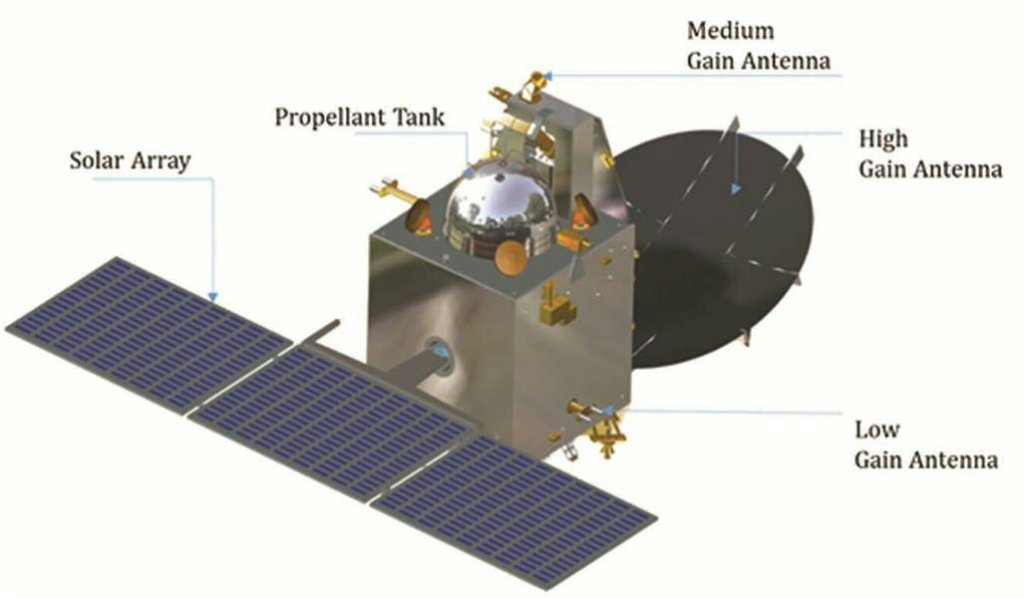
MARS orbiter mission is carrying instruments with well-defined scientific objectives. The orbit considered for the Mars mission is 500km x 80,000km around Mars. Choice of such a highly elliptical orbit is facilitating both localized observations with higher spatial resolution as well as observations with large coverage and high radiometric and temporal resolutions. From the apogee the full Martian disc can be imaged even with a sensor having moderate field of view (FOV) and any target on mars can be continuously observed for more than ten hours providing large integration times that allow detection of very faint signals.
Mars Orbiter Mission science data processing activities include, transforming telemetry data comprising both primary and ancillary into different levels of science data products processed for radiometry and geometry aspects following established universal standards to incorporate all acquisition, calibration information, processing context details to be archived for long term use.
The ground segment for planetary missions comprises four major elements, namely Deep Space Network (DSN), Spacecraft Control Center (SCC), Indian Space Science Data Center (ISSDC) and Payload Operations Centre (POC). The ground segment is responsible for making the data available for the scientists along with auxiliary information, in addition to storage of payload, spacecraft data and product to identified users.
Science and housekeeping telemetry arrives at the ISSDC in form of telemetry packets. Within the ISSDC the raw science data is transformed into Level-0 data product that is uncalibrated in PDS compatible files. Spacecraft transmits data both primary (instrument data) and auxiliary (house keeping data) in a manner through onboard hardware and received using identified specialized ground systems known as Payload Data Acquisition System (PACQ) . If the primary data or science data is compressed onboard for reducing data rates,then it is decompressed in ground processing. Both primary and ancillary data is placed to the storage identified at data archive centre ISSDC.
Mars Orbiter Mission (MOM)
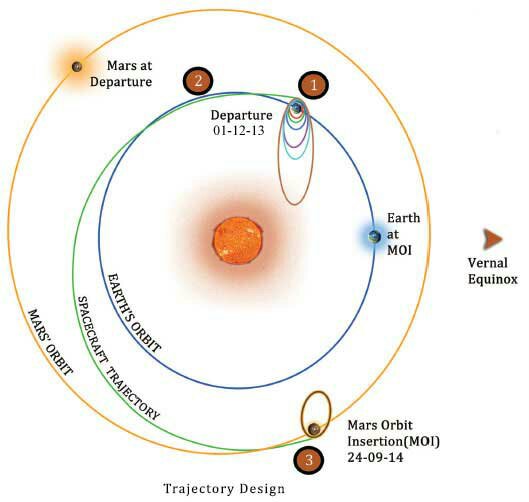
Mars Orbiter Mission (MOM) spacecraft is orbiting Mars in a highly elliptical orbit characterized by nearest point to Mars (periapsis) at around 300 km and farthest point (apoapsis) at ~71,000 km. The inclination of orbit with respect to the equatorial plane of Mars is ~150 degree, as intended. In this orbit, the spacecraft takes ~73 hrs to go round the Mars once. A brief description of the instruments is given below.
Mars Colour Camera (MCC)

Mars Colour Camera (MCC) is an electro-optical sensor imaging surface of Mars in three colours, varying spatial resolution between ~20 m to ~4 km in 16 different exposure modes, depending on its position in orbital plane and illumination conditions. The MCC payload provides data in true colors of Mars covering Red, Green and Blue as Bayer pattern. Important science objectives of MCC include studying morphology of landforms, wind streaks, dynamic processes such as dust storms in different seasons.
Thermal Infrared Imaging Spectrometer (TIS)
Thermal Infrared Imaging Spectrometer (TIS) instrument is aimed to observe thermal emission from Mars surface to detect its temperature and hot spot regions or hydrothermal vents on Martian surface. The TIS is designed to observe emitted infrared radiation from Martian environment in 7–13 µm region of electromagnetic spectrum using a micro bolometer device.
Methane Sensor for Mars (MSM)
Methane Sensor for Mars (MSM) is a differential radiometer based on Fabry–Perot Etalon filters to measure columnar methane (CH4) in the Martian atmosphere at several parts per billion (ppb) levels. This differential signal gives a measure of columnar amount of CH4. The possible finding of methane in Martian atmosphere will provide clues about the presence of life on Mars.
Lyman Alpha Photometer (LAP)
Lyman Alpha Photometer (LAP) is essentially a compact far-ultraviolet photometer capable of providing deuterium to hydrogen (D/H) abundance ratio of Martian exosphere from spacecraft observations. Comparison of the present and initial D/H ratio, estimated from observations of the D/H ratio in comets and asteroids, which are believed to be sources of Martian water should allow us to calculate the amount of hydrogen and, therefore, the water that has been lost over planet’s lifetime. Primary scientific objective of the LAP instrument is to determine D/H isotope ratio of Martian upper atmosphere from the ratio of the measured Lyman-alpha intensities.
The observations would enable us to
i) generate spatial and temporal profiles of hydrogen and deuterium Lyman-alpha intensities,
ii) study of deuterium-enrichment in the upper atmosphere
iii) estimate of the water escape/loss rate.
Mars Exospheric Neutral Composition Analyser (MENCA)
The MENCA instrument is meant for in situ study of the composition of the Martian neutral exosphere. Taking advantage of the highly elliptical orbit of the MOM spacecraft, MENCA data can be used to derive information on the radial distribution and composition of the Martian neutral exosphere.
For More Info Please Visit Following Link:


