01 July 2020
New data obtained using the Hawaii-based James Clerk Maxwell Telescope (JCMT) revealed that the surface of Betelgeuse (commonly known as Orion’s shoulder), recently developed significant “Starspots” which caused an unprecedented dimming of the star. This result contrasts the previously accepted explanation that the reduction in brightness was due to a veil of newly created dust that obscured the star. The research was published today in the prestigious Astrophysical Journal Letters.
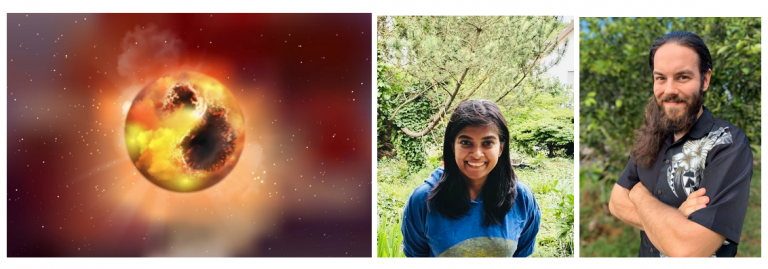
An artist’s rendering of Betelgeuse, Dr. Thavisha Dharmawardena from the Max Planck Institute for Astronomy, and Dr. Steve Mairs from the James Clerk Maxwell Telescope
Beginning in October, 2019, the Red Supergiant star, Betelgeuse, experienced a record-breaking dimming event where it became three times fainter than usual. This phenomenon captured the interest of both professional astronomers and the public, largely fuelled by curiosity in the red supergiant’s demise and whether this change in brightness was heralding an imminent supernova explosion. In an anti-climactic conclusion, however, the star eventually increased in brightness again to its regular appearance. The explanation that emerged at the time was that the dimming was caused by a newly formed cloud of dust that blocked some of the light before it reached our telescopes here on Earth. An independent study led by Dr. Thavisha Dharmawardena, postdoctoral researcher at the Max Planck Institute for Astronomy, Germany, and Dr. Steve Mairs, Senior Scientist at the James Clerk Maxwell Telescope, Hawaii, USA, however, offers the more likely explanation that the surface of Betelgeuse itself underwent a significant change.
Like tuning to a different radio station in a car, telescopes are each tuned to observe different types of light. In this way, observations from different telescopes can be combined to help fill in the whole picture. “By using the James Clerk Maxwell Telescope here in Hawaii, we were able to collect a type of light called ‘submillimetre light’ that is not visible to the human eye,” Mairs explains, “This provided the crucial information that allowed us to conclude that there was no dust in the way; Betelgeuse was feeling shy with a face full of spots.”
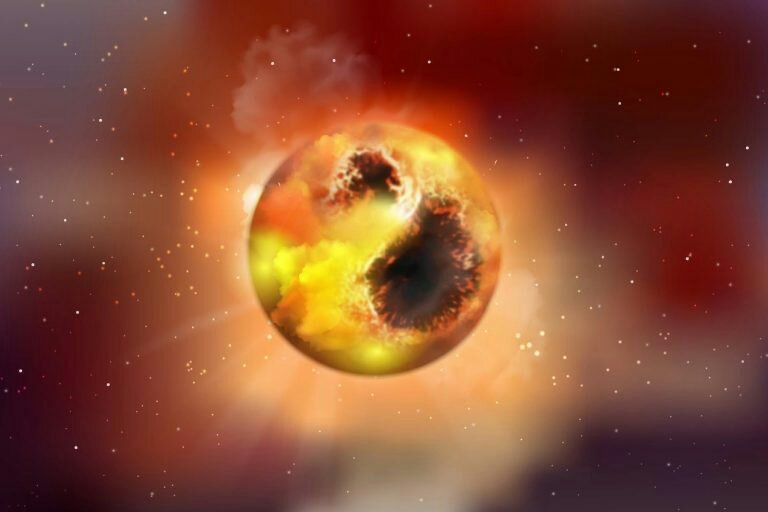
An artist’s impression of the Red Supergiant Betelgeuse. Its surface is covered by large starspots, which reduce its brightness. During their pulsations, such stars regularly release gas into their surroundings, which condenses into dust. (Image: Graphics Department/MPIA).
New JCMT images were obtained in January, February, and March, 2020 while Betelgeuse was faint and they were compared with observations taken over the past 13 years. These previous observations include images obtained by the Atacama Pathfinder Experiment (APEX), a telescope in Chile that observes the same type of light as the JCMT. “What surprised us was that Betelgeuse turned 20% darker during its dimming event even in submillimetre light,” Dharmawardena says “This behaviour is not at all compatible with the presence of dust. It was very exciting to realise that the star itself had undergone this massive change”.
According to the scientists, the simultaneous darkening in visible and submillimetre light is evidence for a reduction in the mean surface temperature of Betelgeuse by 200 °C (360 °F). “However, an asymmetric temperature distribution is more likely,” Dharmawardena explains, referring to corresponding high-resolution images of Betelgeuse from December 2019 that depict an uneven distribution of stellar brightness. “Together with our result, this is a clear indication of huge starspots covering between 50 and 70% of the visible surface, each having a lower temperature than the rest of the surface.” Starspots, similar to sunspots, are common in giant stars, but not on this scale. Not much is known about their lifetime. However, theoretical model calculations seem to be compatible with the duration of Betelgeuse’s dip in brightness.
The team will continue to track the brightness of Betelgeuse with the JCMT over the next year to uncover more details about how the star is physically changing over different timescales. “Previous generations of stars like Betelgeuse have physically manufactured most of the elements we find on Earth and indeed in our bodies, distributing them throughout the Galaxy in massive supernova explosions.” Mairs explains. “While we cannot predict when the star will explode, tracking its brightness will allow us not only to better understand the evolution of an interesting class of stars, but it also helps write a page in our own cosmic story.”
Supplementary information about Betelgeuse:
Betelgeuse, known as Kauluakoko in ōlelo Hawaii, is the nearest red supergiant star to the Earth at a distance of only 500 light years. It is the red shoulder of the constellation Orion. It is so large that if Betelgeuse were to be placed at the location of our Sun, Mercury, Venus, the Earth, Mars, and the asteroid belt, would all be contained inside the star. With such a close proximity, it acts as a unique laboratory to aid in the understanding of the late stages of red supergiant evolution. Massive stars (Betelgeuse is 11 times heavier than our Sun) are important to study as they are the main drivers of chemical evolution in the universe. Stars like Betelgeuse manufacture many of the elements that comprise our bodies and our planet and even before the explosive end of their lives, massive stars undergo episodes wherein they lose material, enriching their surroundings with newly formed chemical elements. These periods of mass loss are accompanied by pulsations with periods of up to a few years.
News Published by James Clerk Maxwell Telescope (JCMT)


