Researchers have confirmed the presence of one large saltwater lake, which was discovered two years ago, and also found three more lakes hidden under the surface of Mars

ESA’s Mars Express spacecraft has discovered several ponds of liquid water buried under the ice in the south polar region of Mars. The spacecraft’s radar instrument, MARSIS (Mars Advanced Radar for Subsurface and Ionosphere Sounding), revealed one underground reservoir in 2018, buried about 1.5 km below the ice.
The radar penetrates the Martian surface and is reflected back to the spacecraft when it encounters liquid water.

Now, taking into account more data and analysing it in a different way, three new ponds have been discovered. The largest underground lake measures about 20 x 30 km, and is surrounded by several smaller ponds. The water is thought to be very salty in order for it to remain liquid at cold temperatures.
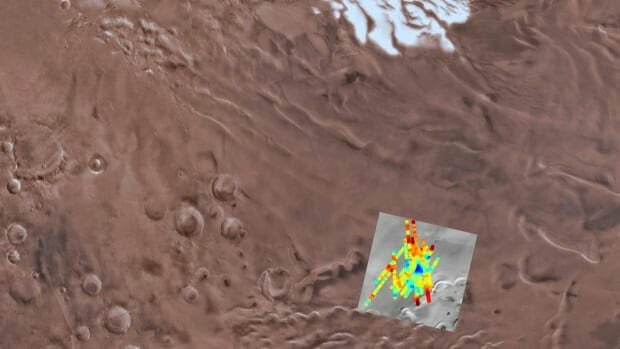
Between 2012 and 2015 Mars Express made repeated passes over the 200 km wide study region in Planum Australe, bouncing radio waves through the planet’s surface and recording the properties of the reflected signal with its Mars Advanced Radar for Subsurface and Ionosphere Sounding instrument, MARSIS.
The radar ‘footprints’ on the surface are represented in the image and are colour-coded corresponding to the ‘power’ of the signal reflected from features below the surface. The brightest reflections are coloured in blue, with data from multiple overlapping orbits defining a 20 km-wide zone corresponding to the triangular shaped patch to the right of centre in this image.
Directly below this patch, under repeating layers of ice and dust at a depth of 1.5 km, is a base layer that has radar properties corresponding to liquid water. Despite the below-freezing temperatures on Mars, it can be kept liquid by the presence of salts, and it may be heavily laden with water-saturated sediments.
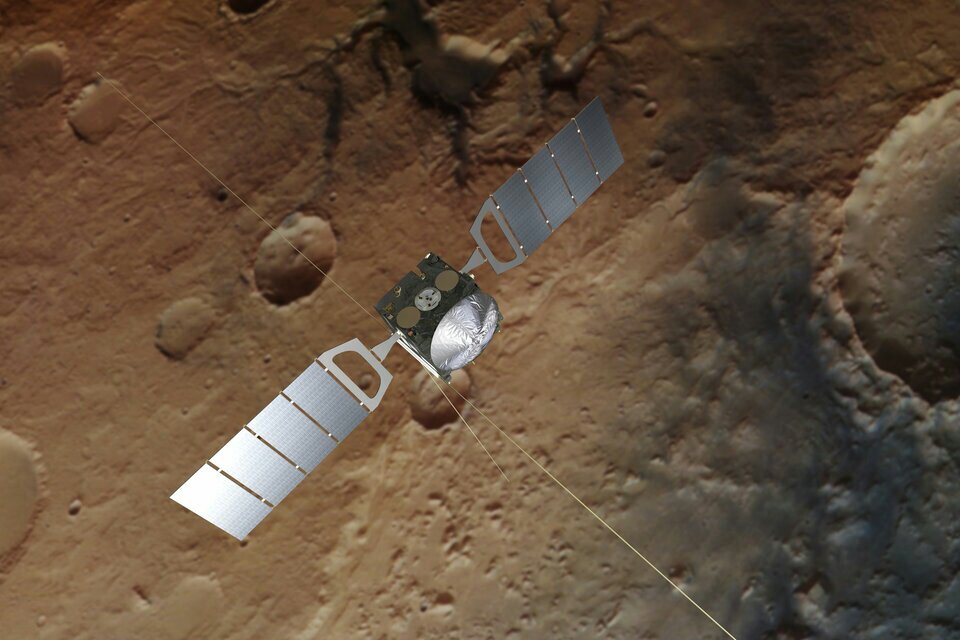
Mars Express with its two 20 m-long radar booms 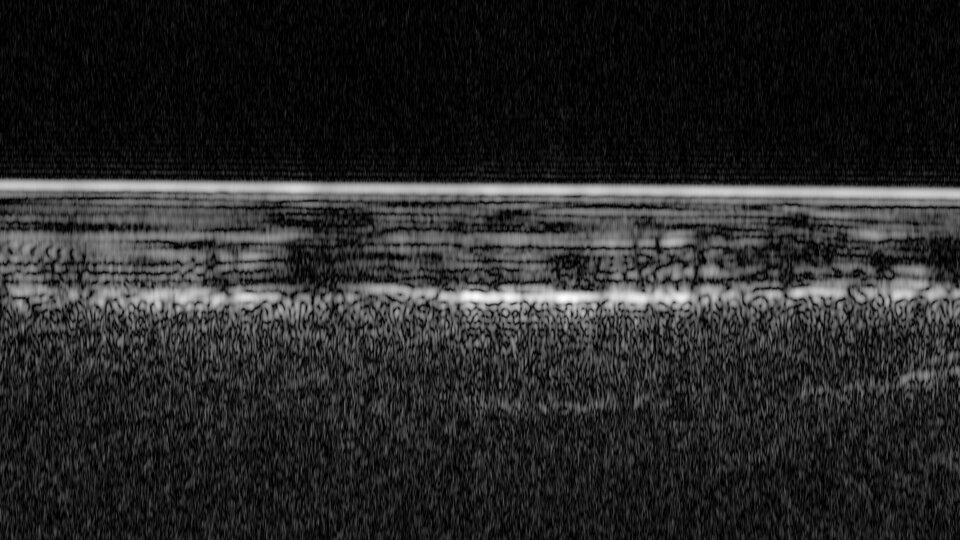
Detecting buried water with radar 
ExoMars image of layered deposits at the south pole of Mars 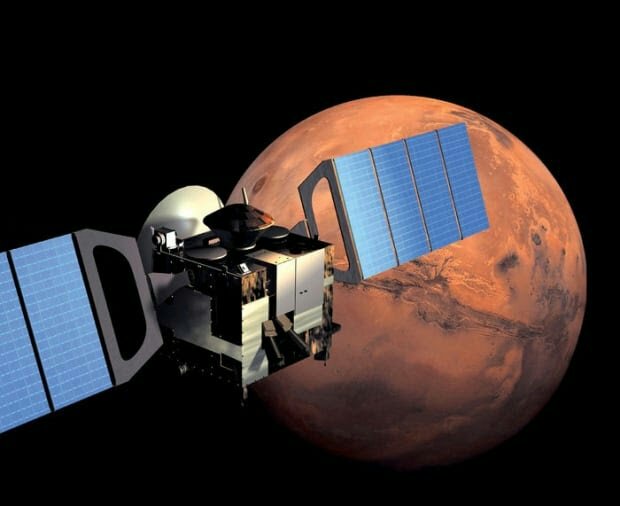
Water once flowed freely on the Red Planet’s surface, but it is not stable today. Mars was once warmer and wetter with water flowing across the surface, much like early Earth. While it is not possible for water to remain stable on the surface today the new result opens the possibility that an entire system of ancient lakes might exist underground, perhaps millions or even billions of years old. They would be ideal locations to search for evidence of life on Mars, albeit very difficult to reach.
Subglacial lakes are also known on Earth, like Lake Vostok in Antarctica. They may harbour unique ecosystems, providing useful analogies for astrobiologists exploring how life can survive in extreme environments. The techniques used to analyse the radar data on Mars are similar to those used in investigations of subglacial lakes in Antarctica, Canada and Greenland
Source: ESA

