A wonderful event for Astronomers seen in science fiction turned into reality. A black hole enjoyed one stellar dessert.
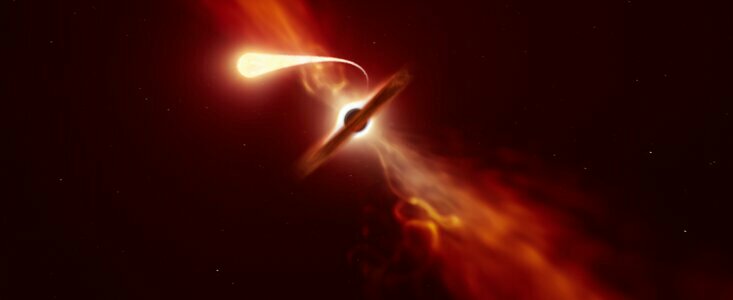
Astronomers were able to witness the event from 215 million light-years away in a spiral galaxy in the Eridanus constellation.
Astronomers saw the light from a star being devoured and ripped apart by a supermassive black hole using telescopes at the European Southern Observatory in Chile. Although it sounds incredibly far away, this event was the closest flaring death throes of a star astronomers have seen to date.
And, the event astronomers witnessed was the “spaghettificaton” of the star.
“When an unlucky star wanders too close to a supermassive black hole in the center of a galaxy, the extreme gravitational pull of the black hole shreds the star into thin streams of material,” said Thomas Wevers, study coauthor and an ESO fellow in Santiago, Chile, in a statement. Wevers was at the University of Cambridge’s Institute of Astronomy as he worked on this research.
When these thin strands of the star’s material fall into the black hole, they release a bright energetic flare that can be detected by astronomers.
“The idea of a black hole ‘sucking in’ a nearby star sounds like science fiction. But this is exactly what happens in a tidal disruption event,” says Matt Nicholl, a lecturer and Royal Astronomical Society research fellow at the University of Birmingham, UK, and the lead author of the new study. But these tidal disruption events, where a star experiences what’s known as spaghettification as it’s sucked in by a black hole, are rare and not always easy to study.
But the researchers had the European Southern Observatory’s Very Large Telescope and New Technology Telescope aimed in the right place after spying a new flash of light last year that was located close to a supermassive black hole.
The study published Monday in the Monthly Notices of the Royal Astronomical Society.
Although the light from the star was incredibly bright, it was still difficult for the astronomers to study because dust and debris created by the event helped to obscure it from view. Energy released during the black hole’s mealtime actually pushed out the star’s debris in a type of curtain.
“We found that, when a black hole devours a star, it can launch a powerful blast of material outwards that obstructs our view,” said Samantha Oates, study coauthor and researcher at the University of Birmingham, in a statement.
Astronomers began observing the event shortly after the star was ripped apart and continued to use different telescopes and instruments to study it in detail over six months as the light from the star initially grew and then faded.
Because we caught it early, we could actually see the curtain of dust and debris being drawn up as the black hole launched a powerful outflow of material with velocities up to 10,000 km/s,” said Kate Alexander, study coauthor and NASA Einstein fellow at Northwestern University, in a statement. “This unique ‘peek behind the curtain’ provided the first opportunity to pinpoint the origin of the obscuring material and follow in real time how it engulfs the black hole.”
Observations were taken in multiple wavelengths of light, including optical, X-ray, ultraviolet and radio light. These different wavelengths revealed a direct link between the bright flare witnessed as the star was consumed by the black hole and the material flowing out from the star.
“The observations showed that the star had roughly the same mass as our own Sun, and that it lost about half of that to the monster black hole, which is over a million times more massive,” Nicholl said.
The study furthers how astronomers understand black holes and this particular event, dubbed AT2019qiz, could be used as a “Rosetta stone” for similar events in the future.

 Technoभौतिकी India