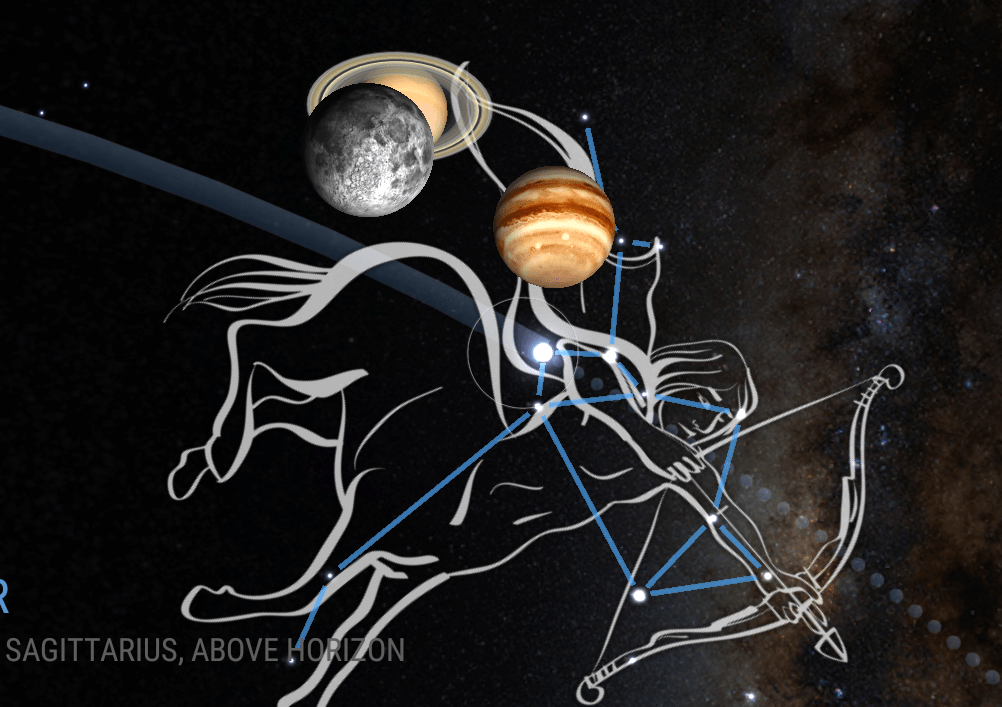
August is bringing lots of opportunities to see the Moon posing with the planets and bright stars.
The trio will appear only a few degrees apart and will provide the perfect opportunity to gaze upon their beauty.
The Moon and Saturn will share the same right ascension, with the Moon passing 2°12′ to the south of Saturn. The Moon will be 10 days old.
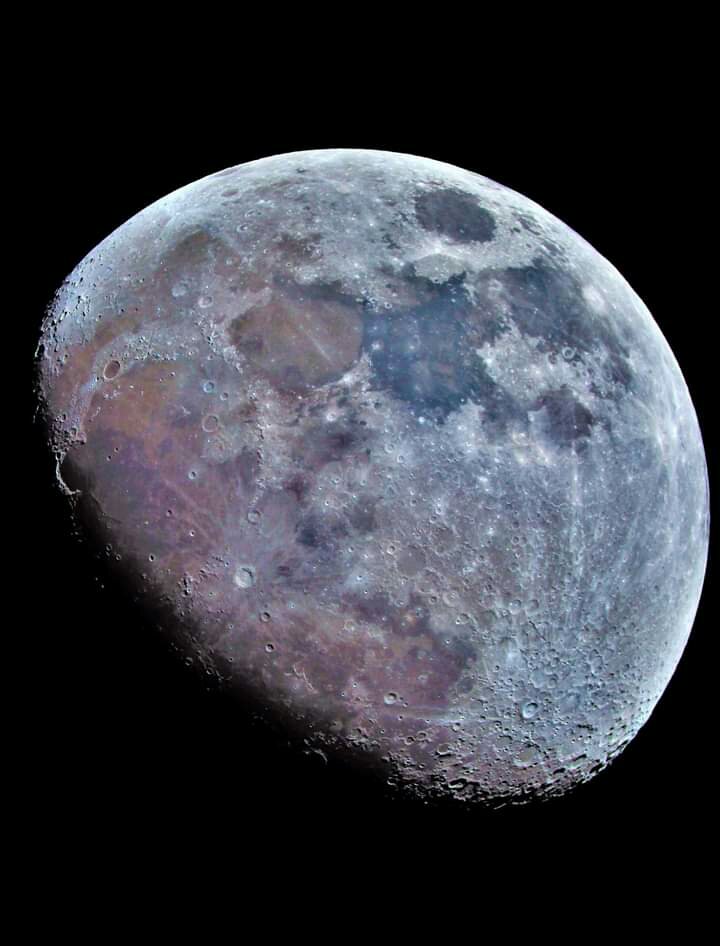
Right after dark look to the south and you’ll see a bright waxing gibbous Moon—90%-illuminated—shining brightly.
At around the same time, the two objects will also make a close approach, technically called an appulse.
This summer is a great time for Jupiter and Saturn watching, especially with a backyard telescope. Jupiter was at its closest and brightest for the year on July 14, and Saturn at its closest and brightest on July 20, 2020, (called “opposition” because they will be opposite the Earth from the Sun). Both will appear to shift toward the west over the summer months, making them visible earlier in the evening sky (and friendlier for backyard stargazing, especially if you have young ones with earlier bedtimes). With clear skies and a small telescope you should be able to see Jupiter’s four bright moons, Ganymede, Callisto, Europa, and Io, shifting positions noticeably in the course of an evening. For Saturn, you should be able to see the brightly illuminated rings as well as the motions of Saturn’s moons, particularly the largest moon, Titan.
From New Delhi, the pair will be visible in the evening sky, becoming accessible around 19:02 (IST) as the dusk sky fades, 27° above your south-eastern horizon. They will then reach its highest point in the sky at 21:40, 40° above your southern horizon. They will continue to be observable until around 02:14, when they sink below 8° above your south-western horizon.
The Moon will be at mag -12.5, and Saturn at mag 0.1, both in the constellation Sagittarius.
The pair will be too widely separated to fit within the field of view of a telescope, but will be visible to the naked eye or through a pair of binoculars.
Meetings with the moon
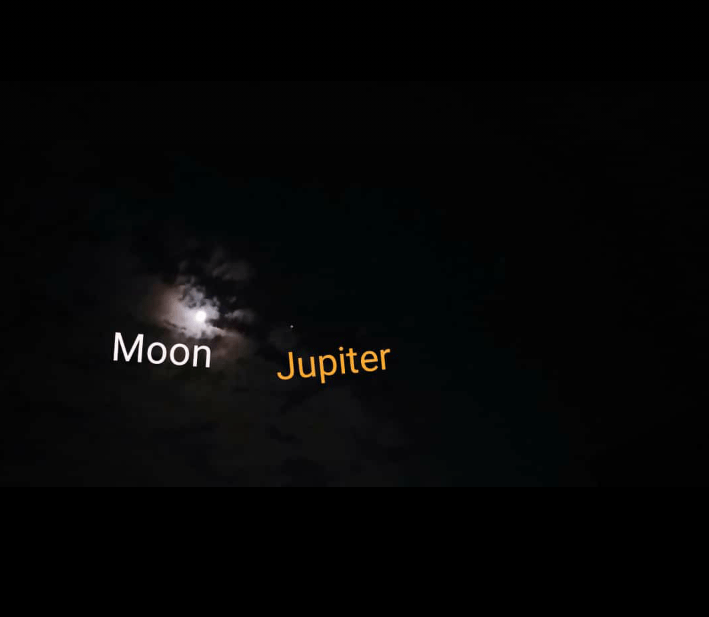
As August draws to a close, however, it will be possible to witness the moon in conjunction with both Jupiter and Saturn on two nights, back to back.
First, on August 28, our moon will be in conjunction with Jupiter. The moon will appear just south of the planet.
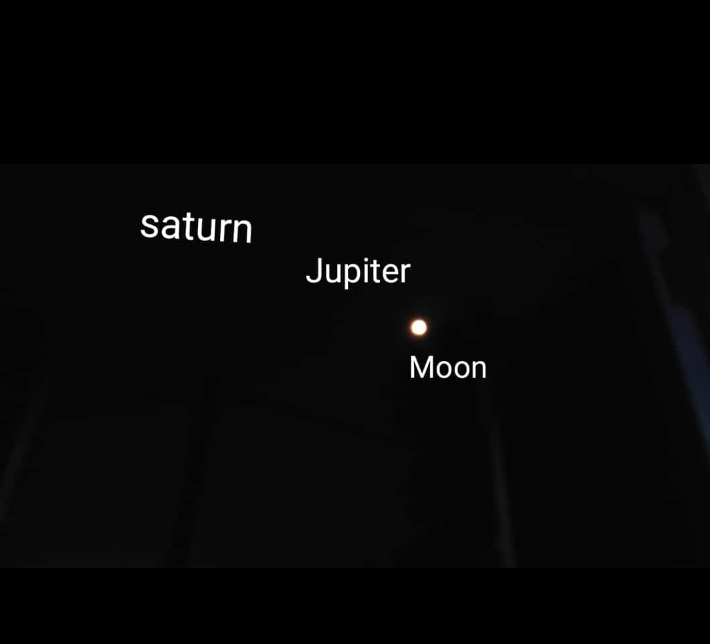
The moon will change its own appearance and grow as it meets Jupiter and Saturn. It is currently what’s described as a “waxing gibbous” moon.
A waxing moon is one which is growing. And gibbous, as defined by NASA, means that the moon is less than a full moon, but larger than its shape in its third quarter.
On August 28, the moon will be about 80% illuminated by the sun and by August 29, it will be about 90% illuminated.
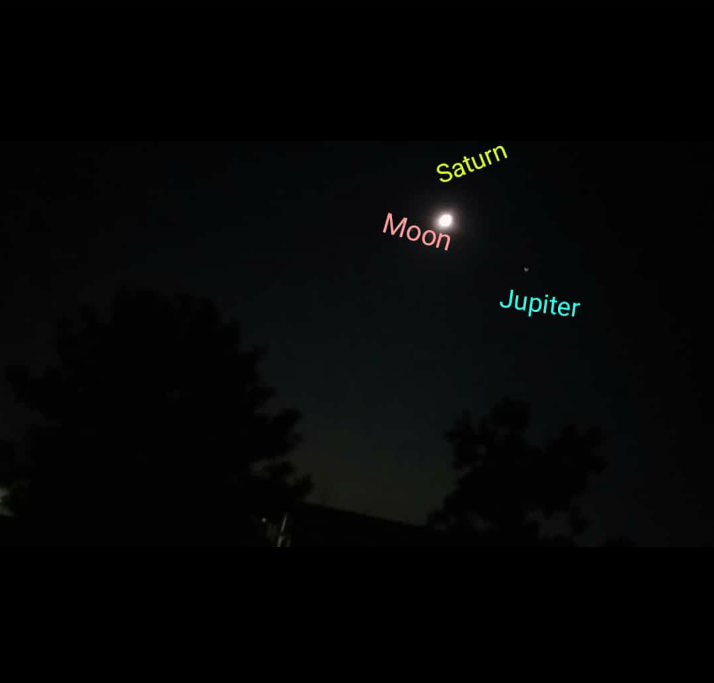
That means the next full moon will follow early morning on September 2.
We have a new moon whenever our moon is aligned directly between the Sun and the Earth — as seen from Earth. That occurs about every 29.5 days. And it’s also known as a conjunction.
It takes Saturn about 30 years to orbit the sun. But great conjunctions are far less frequent and are specific to a close meeting between those two very bright planets, Jupiter and Saturn — as seen from Earth.
It takes Jupiter just under 12 years to orbit the Sun. It takes Saturn just under 30 years to orbit the Sun. So, as Jupiter orbits the Sun faster than Saturn, Jupiter crosses paths, as it were, with Saturn about every 19.6 years — you could say Jupiter “laps” Saturn, as if on a race around the sun.
Great conjunctions
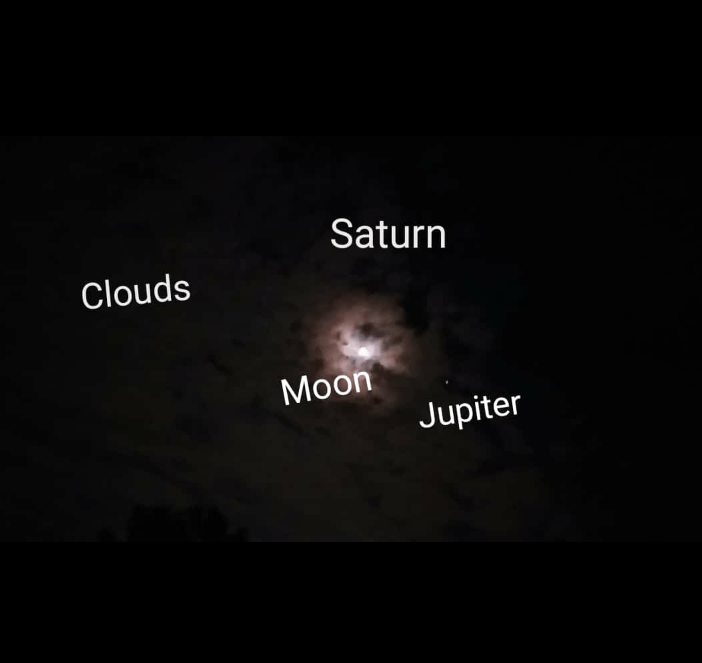
Conjunctions occur frequently. The term is used to describe any two objects in the solar system that align, such as two planets, the moon and a planet, the sun and a planet, or spacecraft.
A conjunction happens when the two objects appear close to the ecliptic — that is, the plane of Earth’s orbit around the sun.
But while the two objects appear to be close viewed from Earth, they are not actually close in space.
Astronomy Enthusias, night-sky-Lovers are in for a treat as the Moon, Jupiter and Saturn will appear all together to create a memorable scene.
For me, this trio conjunction is party-time💃, best celestial event organized by Universe during this pandemic. So, if your are Stargazers🔭 this is perfect opportunity 🌖💫to learn & enjoy the event …or …if your are not, ….no problem…. come out from your home and enjoy this beautiful scene😍…try to understand little bit about astronomy🕵……Good luck 👍
Content Writer: Chanchal Pal
Facebook: Technoभौतिकी India
Instagram: @Technophysicsschool

 Technoभौतिकी India