Brightest Naked eye comet of 2020 with a apparent magnitude of 4.5 approximately.
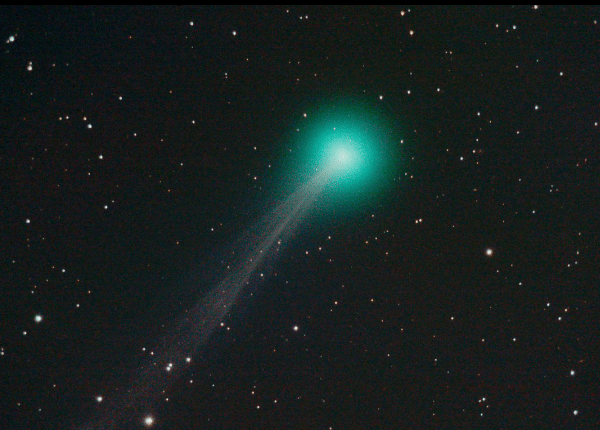
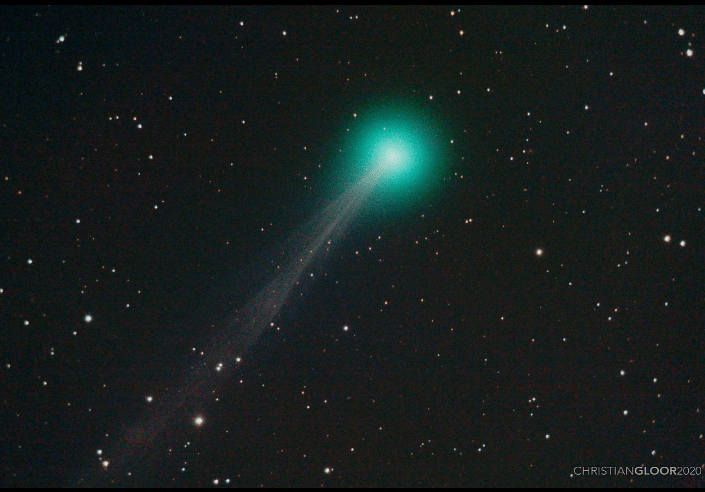
C/2020 F8 (SWAN), or Comet SWAN, is a comet that was discovered in images taken by the Solar Wind Anisotropies (SWAN) camera.
Comet SWAN is difficult to find with binoculars even though it is still near the range of naked eye visibility. The comet has dimmed a small amount since May 3.
Observing
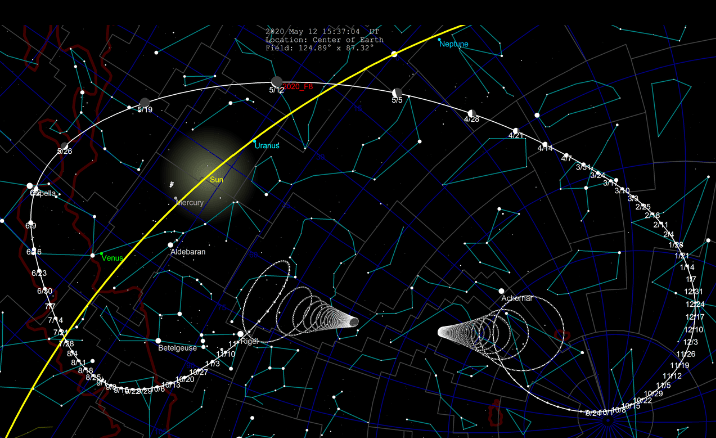
It is 0.7 AU (100 million km; 270 LD) from Earth in the constellation of Perseus and less than 25 degrees from the Sun. It has an apparent magnitude of 6 and would almost be visible to the naked eye from a dark site, but the glare of twilight, zodiacal light, atmospheric extinction and a nearly full moon will almost certainly overpower naked eye observations.
It is now expected to hover closer to magnitude 5. Either way it will be near the glare of twilight. It passed through the celestial equator on 7 May headed northward and will be near the 2nd magnitude star Algol on 20 May. In the Northern Hemisphere it might be best seen at the end of May when it is near the star Capella.
What is Comet?
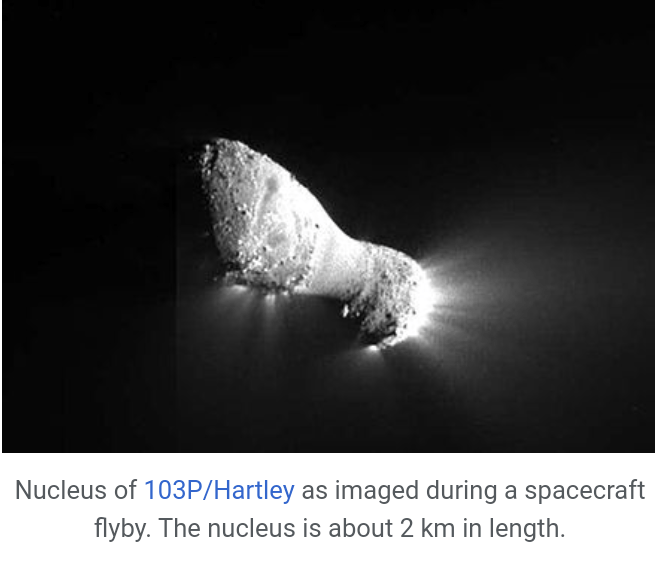
Comets are basically dusty snowballs which orbit the Sun. They are made of ices, such as water, carbon dioxide, ammonia and methane, mixed with dust. These materials came from the time when the Solar System was formed. Comets have an icy center (nucleus) surrounded by a large cloud of gas and dust (called the coma).
Dust particles combine to form icy rocks that join together under the force of gravity. High-speed collisions result in a loosely bound collection of fused rock and ice.
comets have been given the nickname of “dirty snowballs”
Comets are very small in size relative to planets. Their average diameters usually range from 750 meters (2,460 feet) or less to about 20 kilometers (12 miles).
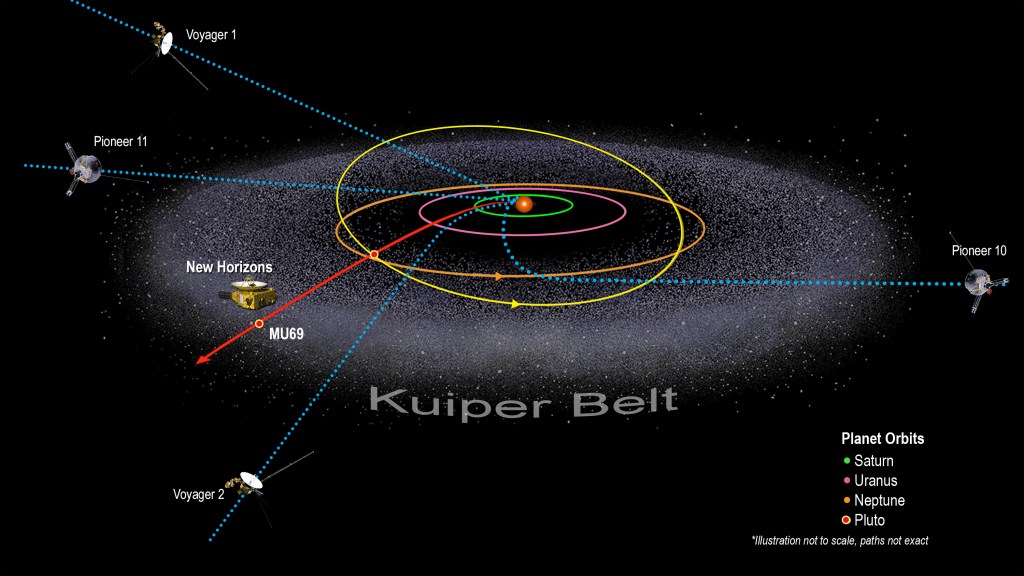
Comets spend most of their lives far away from the Sun in the distant reaches of the solar system.
They primarily originate from two regions: the Kuiper Belt, and the Oort Cloud.
How do comet die?
Once a comet has outgassed all the available volatile, its coma and tail will disappear and the remaining inert nucleus will take on the appearance of a low albedo asteroid. After 500 times or so a comet passes near the Sun, most of its ice and gas is lost, leaving a rocky object.
How does a Comet start?
Short-period comets or periodic comets, originate from a disk-shaped band of icy objects known as the Kuiper Belt beyond Neptune’s orbit, with gravitational interactions with the outer planets dragging these bodies inward, where they become active comets.
How fast is a comet?
There are relatively big varieties, but most of them is between 10 and 70 km/s. If a comet is a periodic comet, that means it needs to have an elliptic orbit around the Sun. That gives an upper limit to its speed of the escape speed from the solar system on the orbit of the Earth. That is around 40 km/s.
Borisov is one of the fastest comets ever seen at a breathtaking speed of over 175 000 km/hr
Credit: #Technoभौतिकी India, #wikipedia

 Technoभौतिकी India